

The missing control layer for business AI conversations.
Servadra gives service businesses a governed first layer for enquiries, sales intent, support requests and human handoff — so AI operates with rules, context and discipline, not guesswork.
This is a public overview. Product depth, roadmap and commercial details are shared privately after context fit.
What is Servadra
Servadra is a governed AI operating layer for service businesses. It is built for the point where ordinary AI becomes risky: when it starts speaking to customers on behalf of a business.
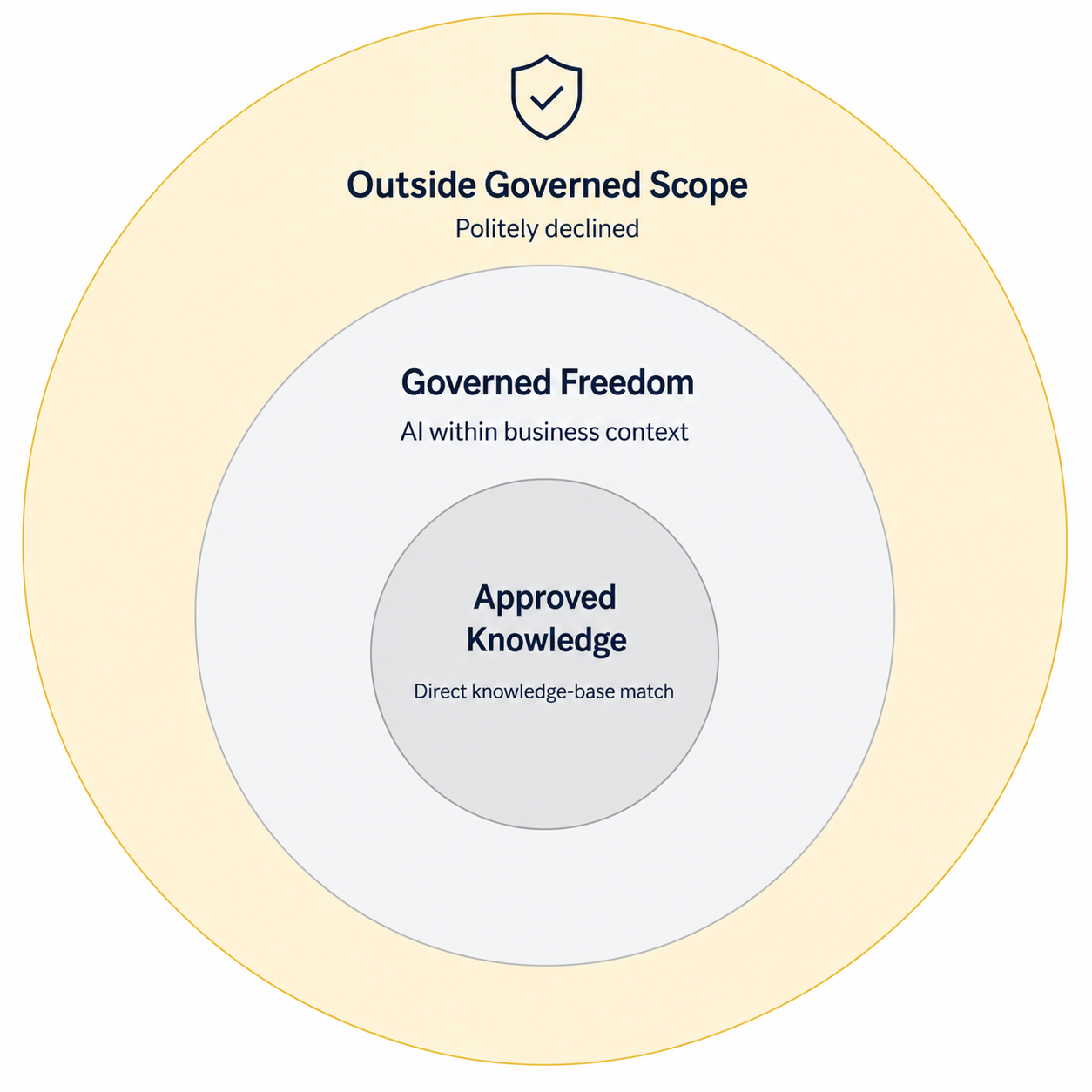
Instead of letting AI answer freely, Servadra runs customer conversations through a client-specific operating rulebook. That rulebook defines approved topics, restricted areas, brand voice, escalation behaviour and handoff rules before the system faces customers.
When a question is within scope, Servadra can answer from approved knowledge. When it reaches a boundary, it is designed to stop, signal the boundary, redirect the conversation or prepare human handoff — rather than inventing a confident answer.
That is the commercial difference. Servadra is not trying to make AI louder. It is built to make AI usable where trust, control and operational discipline matter.
Where Servadra Fits
Servadra sits between lightweight AI chat tools and heavy enterprise customer service platforms.
Service businesses do not usually need another loose AI assistant. They need a controlled first layer that can turn customer messages into structured operational input before the right human team gets involved.
That gap is expensive. Vague sales enquiries waste staff time. Support requests arrive without context. Frustrated customers get handled too late. Routine questions interrupt senior people. And the business has little confidence that AI will stay inside the rules.
Servadra is built for this middle layer: not a full enterprise helpdesk replacement, and not a simple chat widget. It is the governed front layer that helps service businesses understand, structure, answer, escalate and hand over customer conversations with discipline.
What We Solve
Servadra solves the control problem behind AI customer communication.
Once AI starts answering customers, the risk is no longer just whether it sounds fluent. The real risk is whether it says the right thing, stays inside the business rules, spots the right intent, and knows when to stop.
Servadra is built around the failure points that make businesses hesitate to put AI in front of customers:
- Unapproved answers — AI invents pricing, policy or service promises the business never signed off.
- Weak enquiry qualification — vague leads reach staff without context, wasting the first human conversation.
- Missed buying signals — a serious prospect looks like a casual question and slips away.
- Poor escalation timing — urgent or sensitive cases are handled too late, or without enough background.
- Brand drift — replies may be polite, but no longer sound like the business.
- Unsafe learning loops — AI improves loosely, without enough control over what it learns from or how it changes.
Servadra turns these risks into product structure: approved knowledge, intent reading, boundary signalling, escalation discipline, handoff preparation and quality review.
Integrated Where Others Are Fragmented
Most customer-facing AI products solve one part of the workflow: support replies, ticket assistance, automation, or service routing. Useful, but fragmented.
Servadra is designed as a governed operating layer. It brings together client rules, approved knowledge, intent reading, boundary control, escalation discipline, handoff preparation and quality review in one structure.
The comparison below focuses on similar customer operations products, not basic chatbot widgets. Pricing and packaging vary by plan, usage, seats and deployment model.
Legend: ✓ Core ~ Partial ◇ Uncommon — Not typical
| Capability | AI Support | CX Platform | Automation AI | Helpdesk AI | Servadra |
|---|---|---|---|---|---|
| Client-specific operating rulebook | ~ | ~ | ◇ | ~ | ✓ |
| Approved knowledge boundaries | ~ | ~ | ~ | ✓ | ✓ |
| Visible governed-scope signal | ◇ | ◇ | — | ~ | ✓ |
| Pricing / policy guardrails | ~ | ~ | ◇ | ~ | ✓ |
| Multi-intent enquiry reading | ~ | ~ | ◇ | ~ | ✓ |
| Vague enquiry structuring | ~ | ~ | ~ | ~ | ✓ |
| Sales readiness detection | ~ | ~ | ◇ | ~ | ✓ |
| Support / after-sales layer | ✓ | ✓ | ~ | ✓ | ✓ |
| Frustration-aware alert mode | ~ | ~ | ◇ | ~ | ✓ |
| Escalation priority logic | ~ | ~ | ◇ | ✓ | ✓ |
| Structured handoff report | ◇ | ~ | ◇ | ~ | ✓ |
| Response quality review loop | ~ | ~ | ◇ | ~ | ✓ |
| Privacy-aware pattern learning | ◇ | ~ | — | ~ | ✓ |
| Repeatable governed deployment | ~ | ~ | ◇ | ~ | ✓ |
The commercial value is integration. Similar platforms may solve parts of the workflow. Servadra is being built to control how customer conversations are understood, answered, escalated, reviewed and handed over as one governed operating layer.
Platform Foundations Already Built
Servadra is not only a market idea. The working foundation already covers the difficult parts that turn AI from a reply tool into a controlled operating layer.
- Governed client setup — client-specific rules for approved topics, restricted areas, tone direction, service boundaries and handoff behaviour.
- Customer-facing enquiry layer — a website front layer designed to receive, structure and route customer conversations before staff step in.
- Intent-aware handling — the platform is built to recognise different conversation patterns, including early enquiries, buying signals, support needs, frustration and human follow-up intent.
- Boundary control — when a topic falls outside the defined scope, Servadra is designed to avoid unsafe answers and move towards governed redirection or human handoff.
- Structured handoff preparation — human teams can receive clearer context instead of a loose transcript, reducing the cost of picking up the conversation cold.
- Quality review workflow — response quality, weak knowledge areas and repeated enquiry patterns can be reviewed and improved over time.
- Privacy-aware pattern learning — Servadra’s direction is to learn from operational patterns without making raw personal customer data the decision authority.
- Repeatable SaaS deployment model — the product is being shaped around repeatable setup, client configuration and governed rollout rather than one-off custom chatbot builds.
The valuable part is not any single feature. It is that these foundations are being built to work together as one governed operating model.
Commercial Direction
Servadra is not being built as a one-off chatbot service. It is being shaped as a repeatable B2B SaaS model for service businesses that need governed customer conversation handling.
The commercial path is built around three layers: governed setup, recurring subscription, and expansion through additional use cases, channels and partner-led delivery.
- Setup and configuration — each client needs business rules, approved knowledge, tone direction, boundaries and handoff logic before deployment.
- Recurring platform subscription — ongoing access to the governed enquiry layer, structured handling, quality review and operational reporting direction.
- Expansion potential — additional service areas, contact channels, reporting layers and partner-supported delivery create room for account growth over time.
The first commercial focus is service businesses where enquiry quality, support workload, sales readiness and handoff discipline directly affect revenue or operating cost.
Detailed commercial terms, roadmap depth and partnership structures are kept for private discussion after context fit.