
Build new value
from the trust you already hold.
Servadra works with advisors, consultants, MSPs and service providers who want to introduce a structured operational layer to suitable clients — without becoming the software provider.
Help clients work with more order, stay closer to the relationship, and grow together where the fit is right.
Private alignment first. Commercial terms are shared after fit is confirmed.
Who This Is For
This programme is for people who already have client trust.
Advisors and consultants.
MSPs and IT support firms.
Agencies and service providers.
You do not need to become a software reseller. You do not need to build the platform, manage the technology, or take over the client’s operation.
Your role is to recognise when a client may benefit from more structure, introduce Servadra where there is a genuine fit, and stay close to the relationship you already hold.
You bring the trust.
Servadra brings the structure.
Useful if you are new to Servadra:
How Servadra helps service businesses → Example operational scenarios → How Servadra spots intent →

Which Clients Fit Servadra?
The best-fit client is not defined by sector first. It is defined by pressure.
Look for clients who already receive customer enquiries, follow-ups or support requests, but do not have a reliable first layer to structure them before the team gets pulled in.
Unclear enquiries before quotation.
Repeated follow-up after the first reply.
Sales, support and handoff messages mixed together.
These clients often appear in IT support, consultancy, professional services, recruitment, property, training, trading, distribution and booking-based service businesses.
If the client keeps losing time before the real work begins,
Servadra may be a useful introduction.
If you want to match this to client situations, these are the closest references:
Client situations that may fit → When early enquiries are weakly qualified → When follow-up keeps repeating →Problems You Can Point Out
You do not need to tell a client they need AI. Start with the pressure they already recognise.
Your team may not be slow.
Your first layer may simply be unstructured.
Your best people may be spending time on work that should have been clarified earlier.
That is usually a better conversation than selling another tool. It lets you help the client see why enquiries, support messages and follow-ups feel heavier than they should.
Servadra gives you a structured answer to that problem: a governed first layer that helps clarify, separate, route and prepare customer conversations before the team takes over.
You are not pushing software.
You are helping the client name a problem they already feel.
If this sounds like your client’s situation, these references may help:
For weak early-stage enquiries → For repeated follow-up pressure → For the first-layer workflow →
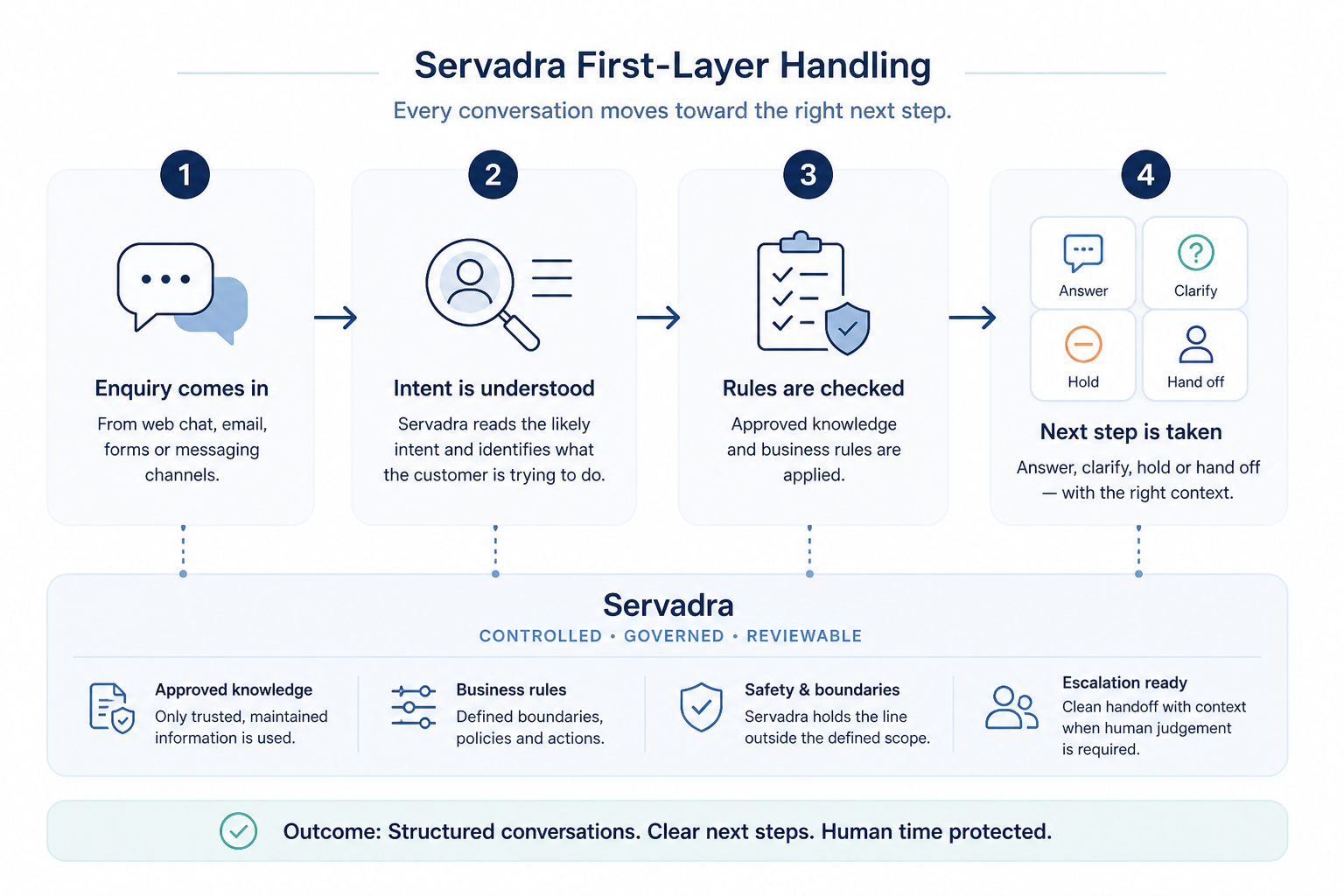
How Servadra Helps
Servadra sits before the human team and helps bring order to the first customer conversation.
It reads the likely intent.
It checks approved knowledge and boundaries.
It answers, clarifies, holds or prepares handoff.
The client does not get another loose chat box. They get a governed first layer that helps enquiries, follow-ups and support requests move towards a clearer next step.
That means the human team receives better context, instead of picking up a messy conversation cold.
Less guessing at the front.
Better handoff when people are needed.
For a client-facing explanation of this workflow:
See how Servadra helps → Review the workflow section → See how intent is spotted →Try Servadra Yourself First
Before introducing Servadra to a client, it helps to experience the system yourself.
Registration is simple.
You can test the enquiry flow.
You can see how structure changes the conversation.
This gives you more confidence when speaking with clients. You are not describing an abstract platform — you are introducing something you have already explored.
Try it first.
Then introduce it where the fit is real.
If you want to explore before a partner discussion:
Register and try Servadra → Open the full Servadra experience → Review how the workflow operates →
How the Partnership Works
The model is simple: you open the right relationship, Servadra handles the governed system, and the client keeps control of their own business rules.
You identify suitable clients and make the introduction.
Servadra explains, sets up and operates the structured layer.
The client keeps control of their knowledge, tone, boundaries and handoff preferences.
Partners may earn referral income when an introduced client becomes a Servadra customer. Exact commercial terms depend on fit, role and agreed partner structure, and are discussed privately after alignment.
Where appropriate, Servadra may also introduce suitable clients to trusted partners for related services. The aim is not one-way referral. It is a professional relationship channel built around useful client fit.
You keep the relationship.
Servadra provides the system.
The client gets more structure.
If you want to understand the operating layer before discussing terms:
Review the Servadra workflow → See client scenarios that may fit → Discuss partner terms privately →Start with a Partner Discussion
If you already work with clients who may benefit from more structure around enquiries, follow-ups, support pressure or handoff, Servadra may give you a useful reason to start a better conversation with them.
Tell us what kind of clients you work with. We will check whether Servadra is a good fit, then discuss partner terms privately if the alignment makes sense.
Private alignment first. Commercial terms are shared after fit is confirmed.